_edited.png)
STK Topanga
Topanga, California
Project Name: STK Topanga
General Contractor: BKB Enterprises
Architect: IDA
Completion Date: April 2025
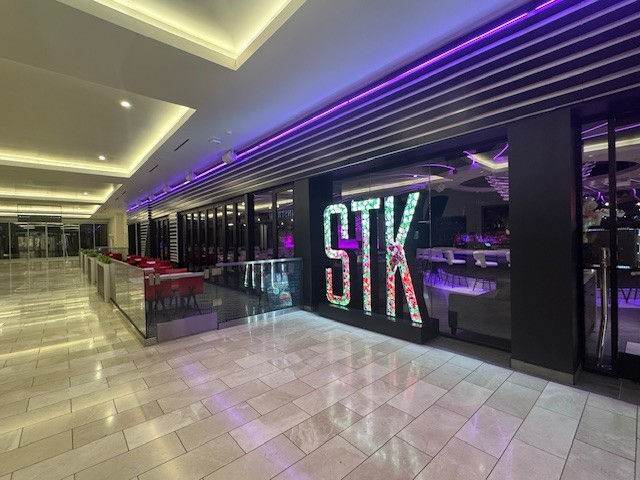


Project Name: STK Topanga
General Contractor: BKB Enterprises
Architect: IDA
Completion Date: April 2025
New Ridge Engineering provided MEP engineering and Construction Administration services for this two-level, high-end steakhouse restaurant. Systems were carefully coordinated with existing conditions as well as architectural plans to enhance customer experience, occupant comfort and safety, and to meet project budget and time constraints.
Electrical Design |
The electrical design supports a two-story structure located within an existing commercial building. The project includes comprehensive power distribution, lighting, equipment connections, and performance standards. Primary power is derived from an existing 480V, 3-phase electrical service. A 150 kVA transformer steps this down to 208Y/120V to serve lighting, general power, and kitchen loads. The distribution system includes multiple panelboards, sized and coordinated to support the load requirements of the restaurant across both floors. The lighting system is fully compliant with California Title 24 energy standards, featuring LED fixtures with dimming capability, occupancy sensors, and time-based controls. All systems have been designed to meet current California Building, Electrical, and Energy Codes.
Plumbing Design |
This two-level shell space was designed for a restaurant tenant and came equipped with plumbing utility stubs of ample capacity. Domestic water was supplied from separate 2-1/2" connections on each floor, with a shared recirculated hot water loop fed by four 199 MBH tankless water heaters. A simplex water softener was also added to treat the moderately hard water supply (124 ppm) and prevent scaling. Grease waste was routed to a shared 15,000-gallon grease interceptor. A total of 2,245 MBH of medium-pressure gas was provided to the kitchen area for cooking and domestic water heating.
Mechanical Design |
Mechanical systems took advantage of existing chilled-water and heating-water stubs. Air-to-air energy recovery systems were used to reduce overall system energy consumption and capacity. This allowed the space to be conditioned without needing to increase the chilled-water distribution to the tenant space. Grease exhaust systems were closely coordinated with architectural ceiling plans to allow for proper slope and cleanout access while maintaining the design of the architectural ceiling features throughout the dining area.